

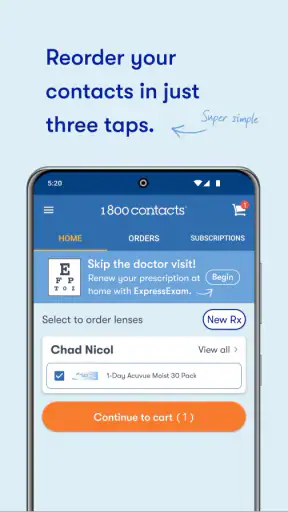
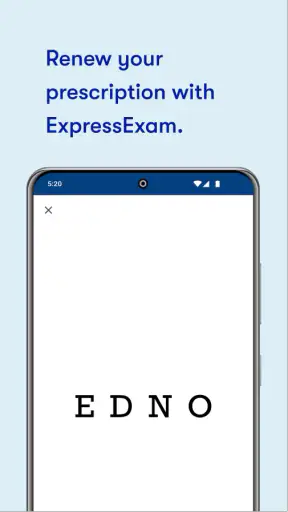
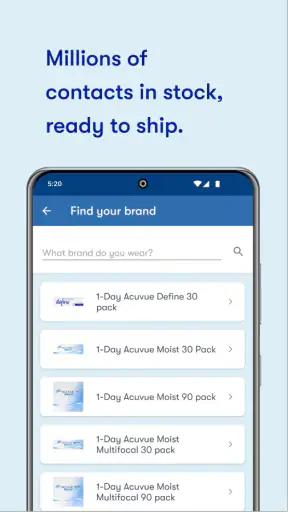
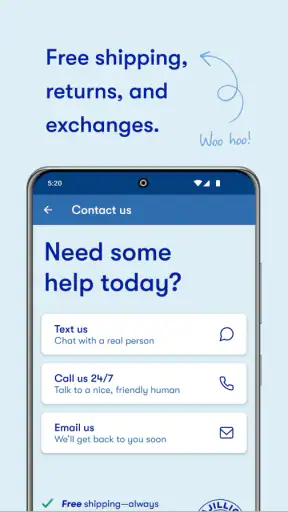
When I first opened 1800 Contacts, I expected a straightforward shopping app for people who already knew which contact lenses they wanted. That is still its clearest purpose, but the experience becomes more useful once I look at it as a repeat-care tool rather than a one-time store. It is a free medical app from 1-800 CONTACTS, and its focus is simple: helping contact-lens wearers handle an essential purchase without turning every reorder into a separate chore.
The first impression is helped by the app’s narrow focus. I am not sorting through unrelated health products, beauty items, or general pharmacy sections. The whole experience is centered on contacts, which makes sense for someone who already wears them and wants a familiar place to manage the next purchase. Its store summary presents it as the world’s largest contact lens store, but what matters to me is whether that promise translates into less effort when my supply starts running low.
That distinction is important. An app can feel impressive during its first few minutes because it is clean, specialized, and easy to browse. The real test comes later, when I need to repeat the same task, check an old prescription, resolve a detail, or decide whether ordering through an app is genuinely easier than using an optician, a browser, or a reminder on my phone. In my experience, this is where 1800 Contacts has a practical reason to stay installed.
From easy first order to useful monthly habit
The first-week appeal comes from reducing the number of decisions around a familiar purchase. If I already wear contacts and know my prescription details, I can approach the app with a clear goal instead of researching what lenses might suit me. That makes it more useful for routine replacement than for someone who is still deciding whether contact lenses are right for them.
I would not treat it as a substitute for an eye examination or professional fitting. A shopping app can help me order lenses, but it should not be the place where I diagnose discomfort, change a prescription on my own, or assume that a different lens is interchangeable with the one I was prescribed. The medical category is relevant here: convenience is valuable, but it does not remove the need for proper eye care.
A realistic everyday scenario is easy to imagine. I am leaving for a trip, notice that my lens supply is lower than expected, and do not want to spend time searching through old emails or visiting several sites. A dedicated contact-lens app can make that moment less stressful, especially if my account and previous order information are already organized. The benefit is not excitement; it is avoiding a small problem becoming an urgent one.
That is also why the app’s audience is fairly specific. It suits people who already have a valid prescription, know the brand or lens type they use, and prefer handling repeat purchases from a phone. It is less suitable for a first-time wearer who needs guidance, someone with changing vision, or anyone experiencing redness, pain, unusual dryness, or blurred sight. Those situations call for an eye-care professional, not a faster checkout.
The app has been available since March 15, 2013, which gives it a more established feel than a brand-new shopping experiment. Its current version is 11.4.4, and it runs on Android 8.0 or later. I see that compatibility as reasonable for people using older phones, although anyone with a very old device should still check performance before depending on it for a time-sensitive order.
What makes the first week feel worthwhile
The strongest early advantage is specialization. Ordinary online shopping can make contact lenses feel like just another product category, while a dedicated service keeps the task focused. That matters when I am trying to match the exact details of an existing prescription rather than compare dozens of vaguely similar products.
Another useful habit is to treat the first order as an information check, not merely a purchase. I would carefully compare the prescription details I enter with the information from my eye-care provider, paying attention to each eye separately where applicable. A quick review before submitting is more valuable than rushing because the app feels convenient. This is one of the less obvious trade-offs: the app can reduce shopping friction, but it also makes it easier to move quickly through a medical purchase, so accuracy still depends on me.
The free price removes a barrier to trying the service, but free does not mean every order decision is automatically right. I still need to consider whether the available lens choice fits my prescription and wearing routine, and whether the ordering process is more convenient than my current method. If I only buy lenses once in a long while, an app may not change much. If I reorder regularly, the value becomes more apparent.
The app’s public reception suggests that many people find the overall experience useful: it holds an average rating of 4.6 from around 32 thousand ratings. I take that as encouraging rather than conclusive. Ratings can tell me that the basic service works for many users, but they cannot predict how smoothly my own prescription, account history, delivery timing, or support experience will go.
Why recurring value matters more than novelty
After the first order, the question changes from “Can I use this?” to “Will this save me effort next time?” That is the point at which 1800 Contacts either earns lasting space or becomes an app I remove after one transaction. Its strongest case is recurring convenience: contact lenses are not usually a one-off purchase, so a focused ordering channel can become part of a predictable routine.
I find the app more convincing for people who wear lenses most days than for occasional users. A daily wearer is more likely to notice when supplies are running down and benefit from having a dedicated place to reorder. Someone who wears contacts only for sports, events, or travel may prefer a calendar reminder and a familiar retailer, especially if they do not want another shopping app on their phone.
One practical tip is to build the reorder habit around supply checks rather than waiting until the final pair. I would check my remaining lenses at a calm moment, confirm the prescription details, and allow enough time for the order to arrive. That approach protects the convenience the app is meant to provide. Relying on any retailer at the last minute turns a routine purchase into a delivery gamble, regardless of how polished the interface is.
The service has reached more than a million installs, so it is clearly not a niche experiment with only a handful of users. It also has around 14 thousand written reviews, which gives prospective users a larger body of public experience to consider. I would still read recent comments with a specific question in mind: are people discussing the shopping flow, or are they describing an issue that could affect my particular order?
For long-term use, I would judge the app by three simple tests. Can I find the correct lens without hesitation? Can I repeat an order without redoing unnecessary work? And can I get help when something about the order needs attention? The first two determine everyday convenience, while the third determines whether the app remains useful when the routine breaks.
The maintenance burden is small, but not zero
Every shopping app creates a little maintenance. I need to keep account information current, check that the prescription I am using is still appropriate, and avoid assuming that an old order means my eyes are unchanged. Contact-lens wear is not like buying a household item where an earlier purchase is always a safe template. My vision and comfort still deserve regular professional attention.
I would also keep my own backup record of the prescription and recent order details. That is not because the app is necessarily difficult to use; it is simply a sensible safeguard. If I change phones, lose access to an account, or need to speak with an eye-care provider, having the information elsewhere prevents the app from becoming the only place I can find important details.
Another maintenance issue is separating shopping reminders from eye-health reminders. A notification telling me to reorder is not the same as a reminder to replace lenses according to their intended schedule, clean and store reusable lenses correctly, or replace the case when appropriate. The app can support the supply side of the routine, but safe wear still depends on habits outside the app.
This is where some users may overestimate its role. If I am looking for a complete eye-care companion with detailed education, symptom tracking, or clinical consultation, a contact-lens store is not the right category of tool. I would choose an optometrist or a dedicated medical service for health guidance and use this app only for the purchasing part that it is designed to handle.
Where repetition can create fatigue
The same specialization that makes the app focused can eventually make it feel limited. Once I know my regular lens order, there may not be much reason to explore the app between purchases. That is not a serious flaw, but it means the app’s lasting value depends on how often I need its core task. It is a utility, not something I expect to open for entertainment or daily discovery.
There is also a mental cost to repeating medical details. Even when the process is familiar, I do not want to rush through the order or tap past information without checking it. If the app asks me to review details that I have already confirmed many times, that may feel repetitive, but the alternative—placing an order with the wrong information—is worse. The best workflow is deliberate rather than hurried.
People with complicated prescriptions or changing lens needs may find ordinary professional contact more reassuring. A store app is most comfortable when the order is stable. If I have recently had an examination, experienced discomfort, switched brands, or been told to use a different replacement schedule, I would speak with my provider before treating a previous order as a shortcut.
Compared with a browser, the app’s advantage is having a more direct, phone-centered route to the same kind of purchase. A browser may be better if I am on a shared computer, dislike installing dedicated apps, or want to compare several retailers at once. Compared with an optician, the app may be faster for a known repeat order, while the optician is better for advice, fitting questions, and changes in eye health. Compared with a general marketplace, the specialized focus is reassuring, but I would still compare the total ordering experience rather than assume specialization solves every problem.
For me, the most useful compromise is to use 1800 Contacts for stable repeat purchases and keep professional care separate. That avoids asking the app to do something it was not built to do. It also prevents convenience from quietly replacing the checkups and judgment that contact-lens wear requires.
Who should keep it installed
I would recommend it to an established contact-lens wearer who wants a dedicated route for repeat purchases, especially someone who prefers using a phone and tends to reorder the same lenses. The free download makes experimentation easy, and the Everyone age rating means it is presented as accessible to a broad audience, although younger users still need appropriate adult and professional guidance for medical purchases.
I would be more cautious about recommending it as a first step for someone who has never worn lenses. That person’s priority should be an examination, fitting, instruction on insertion and removal, and advice about safe replacement. The app may become useful afterward, but it should not be the source of the initial medical decision.
I would also skip it as my main solution if I rarely wear contacts, prefer speaking directly with a local eye-care practice, or need a broader health-management app. In those cases, the extra installation may not justify itself. A simple reminder, a browser, or a trusted professional relationship could be enough.
Before committing to it as a regular tool, I would do one low-pressure test: open the app when I am not nearly out of lenses, check whether my familiar ordering workflow feels clear, and make sure I can identify the details I need. Testing early is a better strategy than waiting for a travel date or a busy week. It lets me discover any account or prescription friction while I still have alternatives.
My long-term verdict
After the novelty fades, 1800 Contacts remains useful for a clear reason: it turns a recurring contact-lens purchase into a repeatable phone task. That is modest, but meaningful. I do not need an app to make lenses exciting; I need it to help me avoid unnecessary searching and last-minute stress while keeping responsibility for my prescription and eye health where it belongs.
Its limitations are equally clear. It is not a replacement for an eye examination, a fitting appointment, or medical advice about symptoms. It may feel unnecessary for occasional wearers, and people who want broad health tools or face-to-face guidance may prefer another option. The dedicated focus can reduce clutter, but it also means there is little reason to open it when I am not managing a lens purchase.
Still, the combination of a free app, an established developer in 1-800 CONTACTS, broad adoption, and a strong 4.6 average gives it a credible place in a regular wearer’s routine. I would keep it installed if I ordered contacts repeatedly and valued a focused mobile workflow. My recommendation comes with one condition: use it as a purchasing aid, not as permission to postpone professional care or ignore changes in comfort and vision.
The lasting value is not the first-order convenience; it is the calmer habit of checking supplies early, verifying the prescription, and reordering before a routine need becomes urgent. For the right wearer, that is enough to earn permanent space on a phone. For everyone else, especially people with new or changing eye-care needs, a professional and a simpler purchasing method may be the better long-term choice.


